What every patient should know after a diagnosis of pancreatic cancer
A guide written by a surgical oncologist who specializes in pancreatic cancer, to help you and your family understand what a thorough evaluation should include — and how to become an informed partner in your own care.
“The most important decision in pancreatic cancer care is often the first one—choosing the right team to guide you from the very beginning.” — On why the first few weeks matter most
A diagnosis is the beginning of a journey that brings many important questions and decisions
Few words are more frightening than “you have pancreatic cancer.” In a single conversation, life changes. There are appointments to schedule, scans to obtain, specialists to meet, and treatment decisions that often feel impossibly urgent. It is natural to think that treatment should begin immediately.
Pancreatic ductal adenocarcinoma (PDAC), the most common form of pancreatic cancer, is an aggressive disease that deserves prompt attention. But one of the most important lessons learned over the past two decades is that moving quickly is not the same as moving thoughtfully.
The goal is not simply to start treatment as soon as possible. The goal is to start the right treatment.
Today we understand that pancreatic cancer is frequently a systemic disease, even when the tumor appears confined to the pancreas on imaging. For many patients, the greatest chance of long-term survival comes from a carefully coordinated strategy that combines chemotherapy, surgery, and — for selected patients — radiation therapy. Just as importantly, the sequence of these treatments matters.
Unfortunately, pancreatic cancer is often diagnosed after it has already spread beyond the pancreas — at diagnosis, approximately half of patients have metastatic disease. Although research continues to advance, metastatic pancreatic cancer is not currently considered curable with today's treatments; in these situations, treatment focuses on controlling the cancer, prolonging life, and helping patients live as well as possible.
For patients whose cancer has not spread beyond the pancreas, there may be an opportunity for treatment with curative intent. Achieving that opportunity depends on far more than finding an experienced surgeon — it begins with an accurate diagnosis, high-quality imaging, thoughtful staging, and a treatment plan built by specialists who care for pancreatic cancer every day.
One of the greatest advances in this field has been the recognition that no single physician has all the answers. This guide was written to help you understand what that evaluation should include, why each step matters, and how to become an informed partner in one of the most important decisions of your life.


George Molina, MD, MPH
Pancreatic & Hepatobiliary Surgical Oncologist · Harvard Medical School
Dr. Molina is a fellowship-trained surgical oncologist specializing in pancreatic cancer and other hepatopancreatobiliary (HPB) cancers. He provides multidisciplinary care for patients with complex pancreatic, liver, and biliary cancers, and conducts research focused on improving cancer care delivery and outcomes.
What high-quality pancreatic cancer care looks like
Excellent care follows a deliberate process. Skipping a step — or deciding before all the necessary information is available — can lead to a treatment recommendation that may not reflect your best options.
Diagnosis
A mass is identified and pancreatic cancer is suspected or confirmed.
High-quality staging imaging
A pancreas-protocol CT of the abdomen and a CT of the chest define the tumor and rule out distant spread.
Tissue confirmation
A biopsy confirms the diagnosis of pancreatic ductal adenocarcinoma. Of note, this might happen before step 2 in certain situations.
Multidisciplinary evaluation
Surgical, medical, and radiation oncology — together with radiology and pathology — review your case as a team.
Personalized treatment recommendation
A plan is built around the biology of your tumor, its stage, and your own health and goals.
Treatment begins
Chemotherapy, surgery, and/or radiation proceed in the sequence best suited to you.
Read the full explanation
Understanding your stage
A diagnosis of pancreatic cancer alone does not determine treatment. Two patients with the same diagnosis may need completely different strategies — the difference is the stage of disease. These are not simply staging terms; they represent four different treatment pathways.
Surgery is possible now
Imaging suggests the tumor can be removed safely and completely. This doesn't automatically mean surgery happens first — chemotherapy beforehand may still be recommended depending on the tumor and your team's approach.
Tumor touches nearby vessels
The tumor partially involves nearby veins or arteries but remains potentially removable. Chemotherapy — sometimes with radiation — is typically given first, both to treat the disease and to observe how it behaves.
Not a surgical candidate — yet
The tumor involves nearby vessels extensively enough that surgery isn't recommended at diagnosis. Modern chemotherapy and radiation have allowed carefully selected patients to become surgical candidates after treatment.
Spread beyond the pancreas
Treatment focuses on therapies that work throughout the body — chemotherapy, targeted therapy where eligible, and clinical trials — alongside supportive and palliative care integrated early.
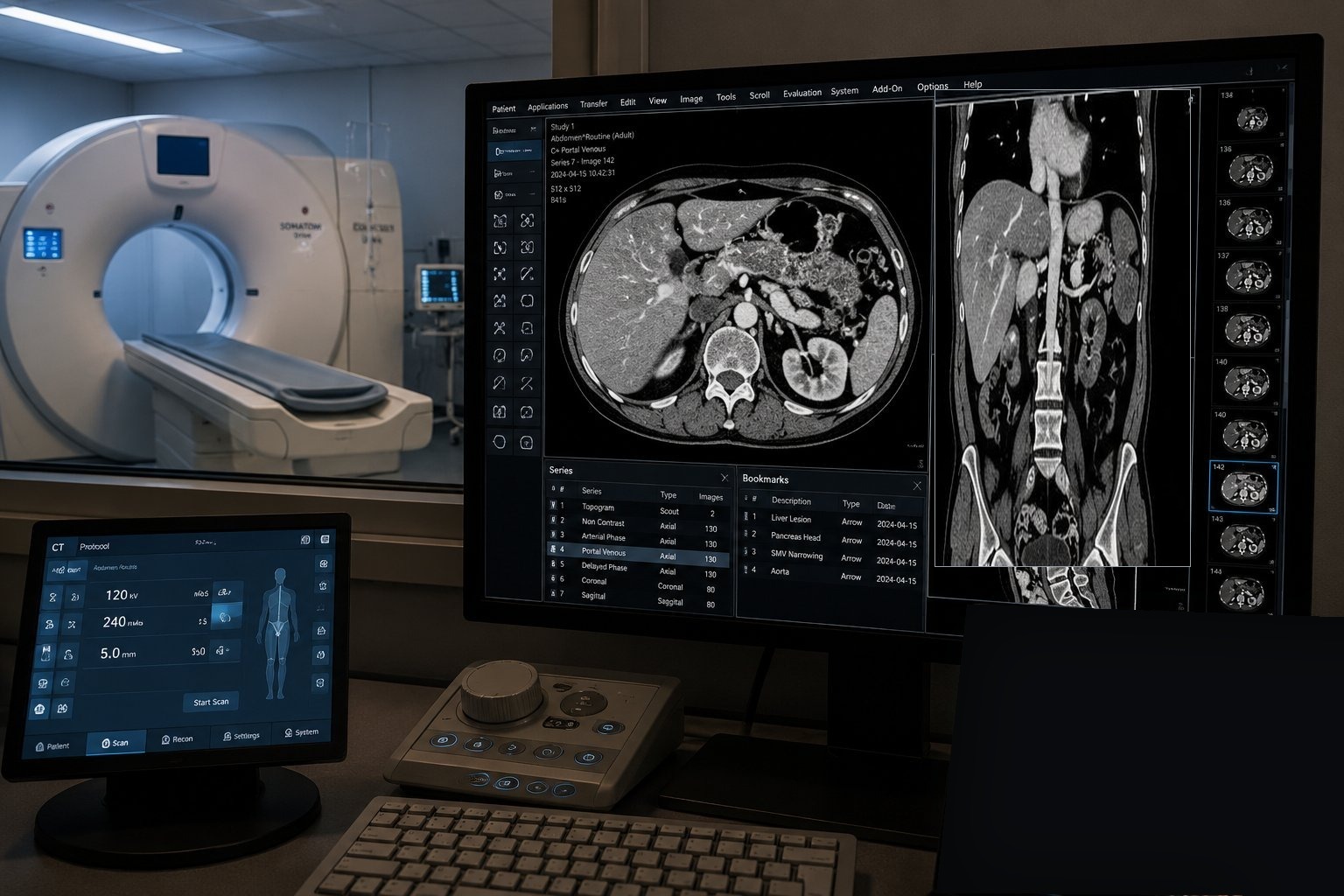
Why the pancreas-protocol CT scan matters most
Before recommending surgery, chemotherapy, or radiation, your physicians need to know: is the tumor confined to the pancreas? Has it spread? Does it involve the major vessels nearby? A biopsy alone can't answer these — high-quality imaging can.
Many patients are surprised to learn there is more than one type of CT scan. A scan performed in an emergency department may identify a mass — but a pancreas-protocol CT is specifically designed to evaluate pancreatic tumors, using carefully timed contrast and thin-section imaging to map the tumor's precise relationship to the vessels around it.
The vessels your team will discuss
Whether a tumor touches, narrows, or surrounds one of these vessels often determines the safest and most effective treatment strategy.
Superior mesenteric vein
Drains blood from the small intestine and joins the portal vein.
Portal vein
Carries blood from the intestines and spleen to the liver.
Superior mesenteric artery
Supplies oxygen-rich blood to much of the small intestine and right colon.
Common hepatic artery
Supplies blood to the liver.
Celiac axis
A major artery giving rise to vessels supplying the liver, stomach, and spleen.
Key takeaways
- A pancreas-protocol CT scan is the cornerstone of staging for pancreatic ductal adenocarcinoma.
- Not all CT scans are designed to evaluate pancreatic cancer — specialized imaging reveals critical detail about the tumor and surrounding vessels.
- Whether the tumor involves nearby arteries or veins helps determine the safest, most effective treatment strategy.
- All patients should also have a CT scan of the chest to complete staging.
- Imaging reviewed by physicians experienced in pancreatic cancer is essential to getting the right treatment at the right time.
No single physician has all the answers
The best decisions are made when specialists from multiple disciplines review your case together — often at a multidisciplinary tumor board, before any recommendation is finalized.
Receiving care at an experienced pancreas center doesn't mean every step must happen there — many patients receive chemotherapy closer to home while staying in close communication with a specialized team. A second opinion at a high-volume center can offer reassurance, or surface options not yet discussed.
Questions every patient should ask
The quality of your care begins with asking good questions. Check these off as you cover them with your team.
Knowledge cannot remove the uncertainty of this diagnosis
But it can help you become an informed partner in one of the most important decisions of your life. That partnership begins with understanding what excellent pancreatic cancer care looks like — and making sure you receive it.